Himalayan Shortwing Brachypteryx cruralis
Etymology:
- Brachypteryx : Greek word brakhus short; pterux
- Cruralis : Latin word of the leg – crus, cruris shin
Distribution: Resident of Central & East Himalayas from Uttarakhand and to NE India
Description: It has a size of 12 12–13 cm; weight of 27·5 g.
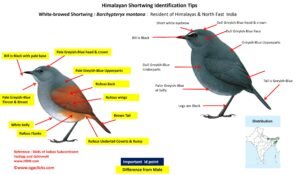
The male is dull dark greyish blue with relatively short concealable white supercilium, paler greyish on central underparts. The iris is dark brown; bill and legs are blackish.
The female is similar, but with smaller white eyebrow and rufous back, wings and tail.
The Juvenile is dark brown, with indistinct buff stippling on head, long whitish streaks below; immature is like adult, but mottled brown, with varying amount of dull chestnut on wings, rump and vent.
Habitat: It is found in montane forest, dense undergrowth, brushwood, thickets, bamboo and bracken tracts in damp shady and mossy oak, fir and rhododendron forest, preferably around treefalls or near streams or in ravines, gulleys and crevasses. It is found at 950–3000 m.
Food habits: It eats small insects, snails, worms. It forages on and just off ground on logs and in lowest branches. On ground it moves very rapidly, like a rodent, making short runs from shelter of rock or leaf tangle to snatch prey item, and returning to cover. It will come out into open clearings and even bare rocky slopes on mountain tops.
Breeding habits: They breed in Oct–Apr. The nest is large but well-concealed dome with circular side entrance, made from moss, leaves, grasses and the like, sited just above ground in small bush or tree. They lay a clutch of two white eggs.