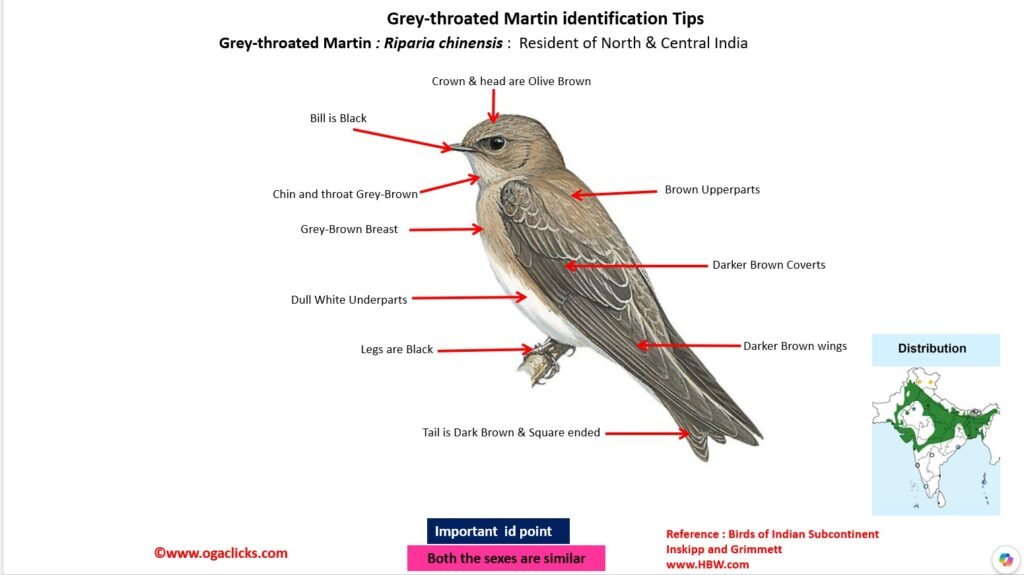
Grey-throated Martin Riparia chinensis
Etymology:
- Riparia : Latin word for river –dwelling derived from ripa- river-bank.
- Chinensis : From China
Vernacular name : Hindi: Abali, Ababil, Ben: Nakuti, Guj: Reth abali, Mar: Rakhi Kanthachi Pankoli
Distribution : Resident in North ,West, Central , East and North East India
Description: It has a size of 10–11 cm.
It is smaller with proportionately slightly longer tail and often somewhat paler rump. The adult has upperparts as mouse-grey or pale grey-brown, chin to upper breast cream-brown to mouse-grey, contrasting with rest of paler underparts, but has more restricted brownish grey on flanks. The dark part surrounding eye is better developed and can extend to sides/base of forehead. The tail looks square-ended or very marginally forked. It has a paler brownish-grey throat and chest. Sexes are alike.
The juvenile has paler crown, buff-fringed upperparts, wing-coverts, tertials and lower back to uppertail-coverts. The throat and breast have pinkish-buff wash and indication of breastband.
Habitat: It is found near rivers, lakes and other waterbodies, especially in breeding season. It also forages over grassland, bush, sand dunes, sewage works, reedbeds, wetlands, rice fields, and estuaries. It is found from sea-level to 1500 m. The non-breeding flocks roost in reedbeds.
Food habits: It eats insects usually close to water’s surface. It has a weak and fluttering flight. It often feeds late in evening. It visits grass fires to catch escaping insects.
Breeding habits: They breed in Oct–Feb. The nest is a burrow excavated by both adults in soft earth or sand, sometimes silt or alluvium, with entrance tunnel. The nest is a pad of dry grasses and fine roots, lined with feathers. They breed in colonies sometimes nests with Sand Martin (Riparia Riparia). They lay a clutch of 2–4 white eggs. The incubation is done by both sexes, mainly by female. Both parents feed chicks, which leave nest at 21 days.