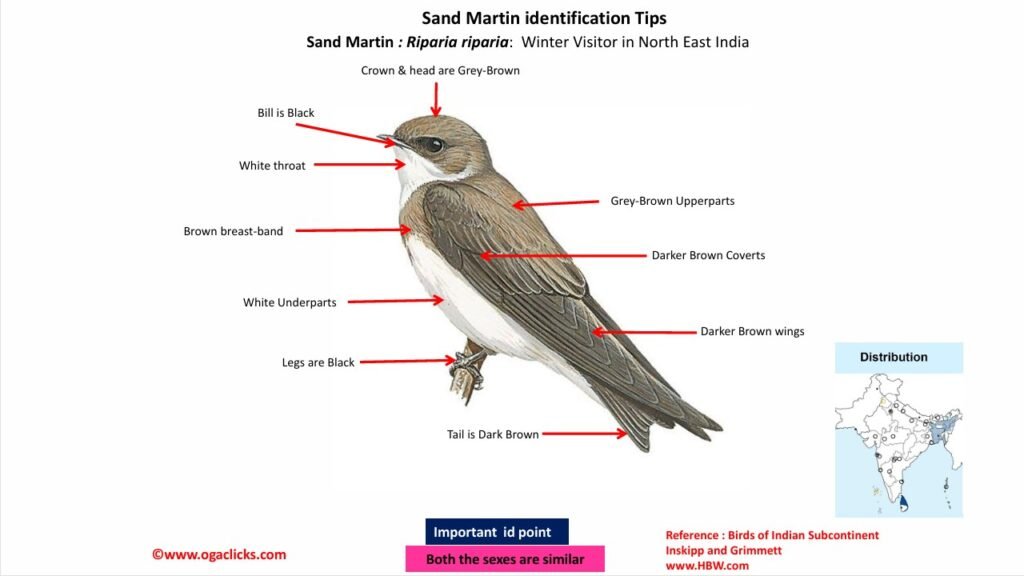
Sand Martin Riparia riparia
Etymology:
- Riparia : Latin word for river –dwelling derived from ripa- river-bank.
- Riparia : Latin word for river –dwelling derived from ripa- river-bank.
Vernacular names : Sind: Ababil paki, Pun: Martin ababil, Guj: Pardeshi retal ababil, Shiyalu reth abali, Mar: Samanya Pankoli
Distribution: Winters across West & North East India
Description: It has a size of 12–13 cm; weight of 11–19·5 g.
It has a small size, white chin and throat and well-demarcated dark breastband. The nominate race is earth-brown or grey-brown above, upperparts have pale feather tips in fresh plumage; remiges and rectrices are darker brown with faint green sheen, tail is shallow forked. The underparts are white, with broad brown breastband; underwing-coverts are dark brown. The tuft of feathers on hind toe at joint with base of tarsus. Both the sexes are alike.
The Juvenile has pale feather edges on upperparts, cinnamon to rufous-buff wash on lores, cheeks, neck side and chin to breast, and buff or cream tinge on lower underparts.
Habitat: It is found in lowland, open country, especially near water, breeding along coasts, rivers and streams, and at lakes and reservoirs, sometimes close to or within areas of human habitation. The breeding habitat is ephemeral; suitability of sites depends on erosion, which both creates new sites and destroys established ones. It prefers new, fresh banks without old burrows. It forages over waterbodies, grassland, farmland, occasionally woodland. It often roosts in reedbeds.
Food habits: It eats insects & spiders. It forages alone or in small or large groups, above ground, or low over water. Mixes freely with other martins. It has a fast and fluttery flight, with shallow and rapid wingbeats. It follows tractors, and occasionally takes insects from ground or water, especially when these form large concentrations. When breeding, it forages mostly close to nest.
Breeding habits: They breed in Apr to Aug. They have two broods in most of range. They are socially monogamous, but extra-pair paternity also occurs. They are colonial, burrows close together, with small area around burrow entrance defended. The male initiates burrow-excavation; then attracts female by singing and flying in circles around entrance, then perches at or hovers in front of it and displays throat patch. The male sings, sometimes with quivering wings, before mounting female for copulation. The males frequently chase females to mate with them, also closely follow own mate when she is fertile. The burrow is dug by both sexes, mainly male, over 4–5 days near banks of rivers, streams and lakes, sandy cliffs and dunes, sand and gravel quarries. They lay a clutch of 3–6 eggs. The incubation starts 1–2 days before clutch is complete, by both sexes, usually female at night. The incubation period is 12–16 days. The eggs hatch over 1–3 days; chicks are fed by both sexes. The fledglings return to burrow for 4–5 days, fed by parents for up to a week, form crèches during day and roost in burrows. Recorded longevity 9 years.