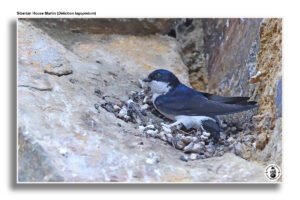
Siberian House Martin Delichon lagopodum
Etymology:
- Delichon : Anagram of Genus Chelidon( Greek word khelidon for swallow.) for Martins
- Lagopodum : Greek word – lagōs hare; podos foot { Hare footed}
Distribution: Winters in Upper West Bengal and Sikkim and extreme North East India
Description: It has a size of 13–14 cm.
The adult has very clean blue-black and white plumage, with sharply defined cap not extending to cheeks or chin. The upperparts are steel blue-black, strongly glossed and contrasting with white rump patch, uppertail coverts and lower back, and very white and clean underparts, from chin to undertail coverts. The underwing coverts are whitish grey. The bill is short and black, eyes are black and has white-feathered legs and greyish-pink feet. In non-breeding plumage it has white rump, face-sides, throat and flanks mottled brown, grey, and female has greyer underparts.
The juvenile has white parts of adults duskier.
Habitat: It is found in open areas, valleys, rocky hillsides and including towns and villages, where it nests; often in mountainous areas. It roosts in nests, sometimes communally, and on trees and cliffs. It is also known to sleep on the wing, especially in winter quarters. In winter seen up to 2,565 m.
Food habits: It eats insects. It forages in flocks, sometimes with other aerial feeders. The flight is slow, usually high up. It occasionally perches on ground, rocks or vegetation to pick up insects. It will follow ploughs and large animals to feed on flushed insects.
Breeding habits: They breed May to September. They have two broods. They are socially monogamous, but extra-pair paternity occurs, with heavier males more likely to secure more fertilizations. The nests are often clustered together, abutting each other, small area around the entrance is defended. The male attracts female by calling and following her, approaches and sings when she perches, potential partners often initially mutually aggressive; copulation mostly inside nest. The soliciting male, if accepted, seizes female’s crown or nape and mounts. The male guards the mate during nest-building and egg-laying. Nest is built by both sexes in 8–18 days. The nest has a small entrance hole near top, made of mud pellets, lined with vegetable fibers and feathers. They lay a clutch of 1–7 eggs. The incubation is done by both sexes for a period of 14–16 days. The eggs hatching is asynchronous. The chicks are brooded by both sexes. The fledging period is 22–32 days, depending on brood size and weather; fledglings return to nest to roost for several days, fed by parents for a few days, sometimes stay in colony for several weeks. Oldest recorded bird lived for 14 years & six months.