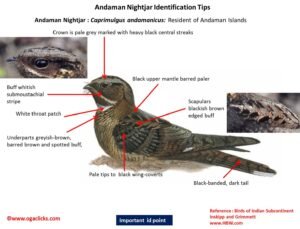
Andaman Nightjar Caprimulgus andamanicus
Etymology:
- Caprimulgus: Latin word capra – goat; mulgere –to milk . The nightjar was assumed to drink goats’ milk and injure the goats
- Andamanicus : From Andaman islands in India
Vernacular Names: Ta: Padukai kuruvi, Mal: Ra chucko
Distribution: Resident of Andamans
Details: Size of 24–26 cm. It is a mid-sized, blackish-looking nightjar, with a paler grey crown marked with heavy black central streaks, paler lower mantle and tertials, black upper mantle barred paler, complete throat-collar white in male, buffier in female. It has dark brown cheeks, distinctly pale tips to wing-coverts, bright rufous bars on bases of primaries, narrow black-banded, dark tail. The breast is grey-frosted, and narrowly pale-barred dark posterior underparts. In flight, male shows narrow white primary patch, becoming rufous at edges, and moderate white tail-corners while it is dull buff in female.
Habitat: It is found in open forests of teak, relatively open country with scattered trees and also mangroves.
Food habits: It eats beetles, moths, mantises, bugs, ants, winged termites and grasshoppers. It hawks over mangrove habitats at dusk.
Breeding habits: They breed in Feb–Apr. They are single-brooded but may re-lay if first clutch is lost. They lay a clutch of 1–2 salmon-pink eggs, with purplish-red markings, s. The incubation is done mainly by female during day. The adults threatened at nest-site perform injury-feigning distraction display.