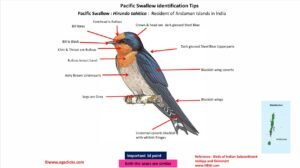
Pacific Swallow Hirundo tahitica
Etymology:
- Hirundo : Latin word for Swallow
- Tahitica : From Tahiti
Distribution : Resident of Andaman Islands.
Description: It has a size of 3 cm.
The adult has rufous-chestnut forehead, crown and upperparts are glossy steel-blue; wings and tail are brownish-black, tail is slightly forked, pale margins on inner webs of rectrices except inner two pairs. The throat rufous-chestnut, rest of underparts are brownish-black, undertail-coverts are grey brown with dark subterminal band and pale tips.
Both the sexes alike. The juvenile is duller, rufous areas paler, short tail.
Habitat: It is found in vicinity of cliffs, including locally near the sea, near rivers in valleys, above or below forest cover, provided the understorey is not dense, over cultivation and sometimes gardens, is always observed close to water. It is found up to 1000 m.
Food habits: It eats flying ant, flies, beetles and termites. It forages alone or in groups. The flight is fast, with frequent turns and short glides.
Breeding habits: They breed in Nov and Dec. They nest in solitary or in small loose groups. The nest is built by both sexes. The nest is a half-cup made of mud pellets, lined with dry grass, rootlets, lichens and feathers, sited on cliffs or dykes, in trees, and on buildings, in tunnels or in small caves. They lay a clutch of 1–2 eggs.