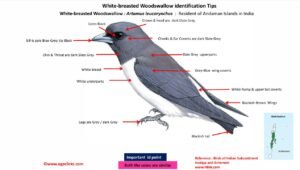
White-breasted Woodswallow Artamus leucorynchus
Etymology:
- Artamus : Greek word for Butcher. The woodswallows were formerly known as swallow-shrikes, combining the characters of swallows and of shrikes (butcherbirds)
- Leucorynchus : Greek word leukos –white ; rhunkhos- bill
- Humei : Allan Octavian Hume (1829-1912) English civil servant in India
Distribution :
- l.humei: Resident of Coco Is (N of Andamans) and Andaman Is
Description: It has a size 17·5–19·5 cm; weight of 36–49·6 g. The nominate race has head, chin, throat and upperparts as dark slate-grey to blackish-grey or dark brownish-grey. The rump is white and uppertail-coverts; primaries and tail are blackish, remiges and tail have thin white tip when plumage is fresh. The underparts are white to creamy white; iris is dark brown; bill is pale blue-grey, tip is black; legs are dark blue-grey. The sexes are similar.
The juvenile is similar in pattern to adult, but more dark brownish with pale feather tips above, underparts sometimes washed light buff, upperwing-coverts and breast feathers tipped rusty or buff, tail more broadly tipped whitish, bill and legs are brownish-horn.
Races vary in overall size, bill size and wing length, also in colour of head and upperparts: Race humei has head to chin and throat bright slate-grey, paler than nominate, bill is shorter.
Habitat: It is found in open country with scattered trees, cultivation, light woodland, and mangroves and in forest clearings. It is found from sea-level to 1500 m.
Food habits: It eats insects. Prey is usually harvested in flight above canopy; perches conspicuously before making aerial sorties. It forages singly or in small groups.
Breeding habits: They breed in Apr-Jun. They sometimes breeds co-operatively, with up to five individuals attending a single nest. The nest is built by both sexes. The nest is an unlined cup made of sticks and grass, placed in spout or hollow branch or in fork of tree, or often in old nest of other bird species. They lay a clutch of 2–5 eggs. The incubation of eggs and feeding of nestlings by both sexes, helped by other group-members. The fledglings attended by both parents, and by helpers, for up to 50 days or more after leaving nest.