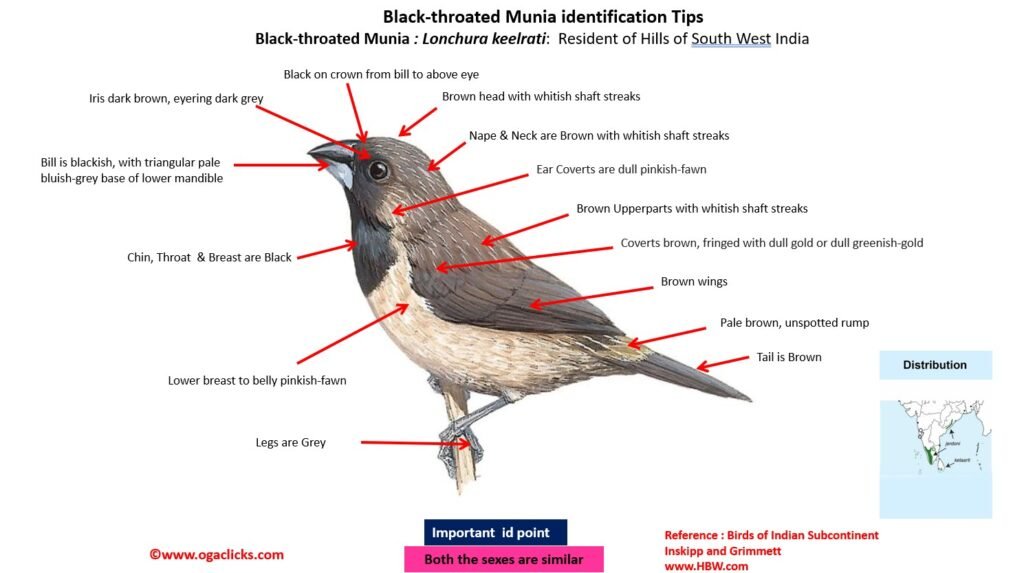
Black-throated Munia Lonchura kelaarti
Etymology:
- Lonchura : Greek word lonkhe – spear-head, lance; oura – {Spear like tail}
- Kelaarti : Named after British Zoologist -Col. Edward Frederick Kelaart (1818–1860)
-
- Jerdon : Thomas Caverhill Jerdon (1811-1872), British Army surgeon and ornithologist
- Vernayi : Arthur Stannard Vernay (1877-1960) English/US antiquarian, collector
Vernacular Names : Ta: Nellu kuruvi, Mal: Tottakaran, Sinh: Wee kurulla, Mar: Kalya Galyachi Manoli
Distribution :
- k. vernayi – East India (South Odisha and North East Andhra Pradesh)
- k. jerdoni – JERDON’S Munia : South West India (Goa, Karnataka, Kerala and West Tamil Nadu; North of Pune
Details : Size of 12 cm; weight of 9·5-17 g. The male of nominate race has face to throat and center of breast as black, crown to lower back is brown with whitish shaft streaks, rump is black with small white cruciform spots. The uppertail-coverts are brown, fringed with dull gold or dull greenish-gold, upperwing and tail are dark brown. The rear ear-coverts to side of upper breast are tinged dull pinkish-fawn, rest of underparts are blackish with white anchor-shaped markings, becoming longer streaks on undertail-covert. The iris is dark brown, eyering is dark grey; bill is mostly blackish, with triangular pale bluish-grey base of lower mandible; legs are grey. The female is like male, but often more spotted on rump. The juvenile is unmarked brown above from crown to uppertail-coverts, cheek is buff, throat, belly and undertail-coverts are buff, breast is light rufous with thin black bars, bill is dark grey.
The Race jerdoni is black on crown from bill to above eye, rump is paler brown than nominate and unspotted (or with small white spots), ear-coverts to side of breast are buff, lower breast to belly is pinkish-fawn, cross-marks restricted to lower belly and undertail-coverts. The juvenile is warmer brown above and duller and more weakly barred below than nominate, undertail-coverts are indistinctly streaked.
The race vernayi is paler, black on crown is restricted to forehead, rump is brown with pinkish-white cross-like marks, uppertail-coverts are light yellowish-brown, ear-coverts to side of breast are buff, breast and upper abdomen are pale pinkish-buff, lower belly is pearly pink with cross-marks. The juvenile is paler brown above.
Habitat: It is found in forest edge and grassy clearings, Lantana scrub, tea and coffee plantations, and gardens. It is found from foothills to 2100 m.
Food habits: It eats Grass seeds, flowers and seedheads of chickweed and groundsel, rice; probably also some insects. It takes small seeds from ground. It forages in small groups; in non-breeding season in larger flocks, often mixed with other members of its genus.
Breeding habits: They breed in Mar–May and Aug–Nov. The nest is built by both sexes. The nest is a compact sphere made from grass, lined with finer grass, often placed in tree or against building. They lay a clutch of 5–7 eggs. The hatchling has pale skin with sparse light grey down on back, palate pale yellow with black bar.