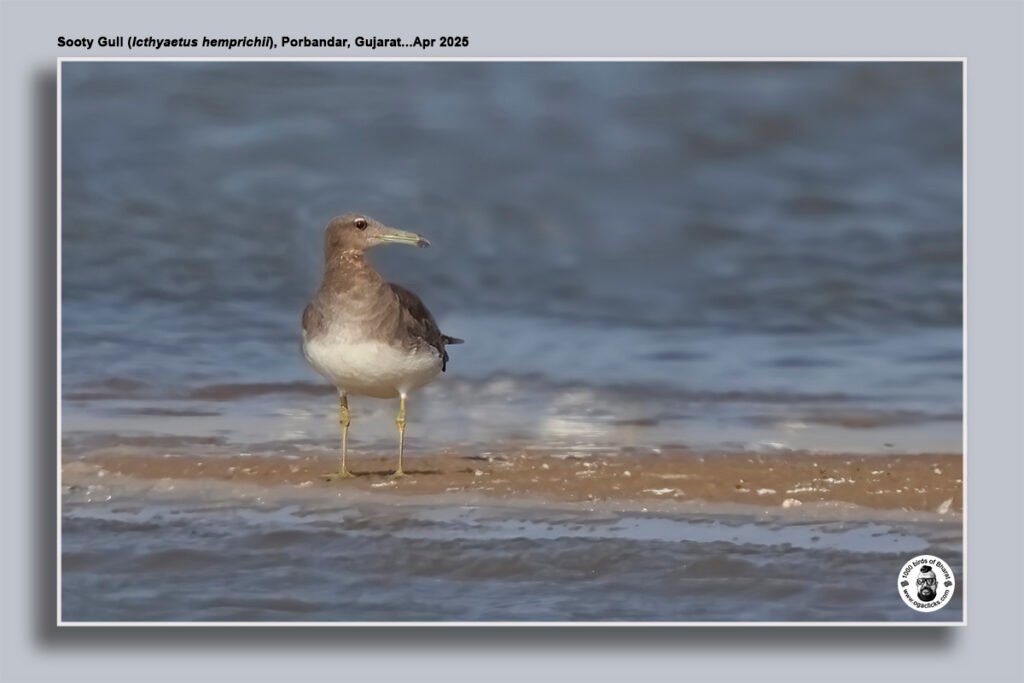
Sooty Gull Icthyaetus hemprichii
Etymology:
- Ichthyaetus : Greek word ikhthus – fish ; aetos –eagle
- Hemprichii : Named after German naturalist FriedrichWilhelm Hemprich (1796–1825)
Vernacular Names : Mar: Kajli Kurav
Distribution in India: winter visitor in Coast of Gujarat.
Description: It has a size 43–48 cm; weight of 400–510 g; wingspan is 105–118 cm.
It is a dark gull, with long legs and a long bicoloured bill. It is large, brown, longer-winged and stouter-billed. The breeding adult has a blackish-brown hood extending on to the upper breast as a bib. It shows an extensive white collar on the neck sides, narrower at the rear, and a narrow white crescent above the eye. The mantle, back and upper breast are greyish brown. The wings are dark brown above and below with a white trailing edge to the inner wing. The belly, rump and tail are white. The long, heavy bill is yellowish green, with a red tip (extreme tip is yellow) bordered at rear by black ring. The legs are dull yellowish olive; iris is brown, orbital ring is red.
The juvenile is brown with a white rump, tail-base and belly and a black distal tail bar. The head is often paler; upperpart feathers have pale edging; eye is dark; bill is blue-grey with black tip; legs are grey.
The first-winter birds are similar but have a uniform brown mantle and scapulars. Second winter birds show blacker flight feathers and a suggestion of the neck ring; the tail retains some black.
Habitat: It is maritime, mainly occurring and breeding along coasts and on islands. Hardly ever seen inland but vagrant immatures stray inland. It is widely commensal with humans and commonly associates with fishermen, following boats and frequenting harbours, or even sizeable ports,. It also feeds on mudflats and frequently rests on piers, buoys and fishing boats.
Food habits: It eats fish and offal, tern eggs and chicks, and turtle hatchlings. It is opportunistic; scavenges along shoreline, usually alone, but highly gregarious at times. It is Kleptoparasitic on conspecifics and other species; serious predator of other seabirds. It takes advantage of human intrusions to steal eggs; takes prawns or dead fish from net. It feeds mainly inshore and in intertidal zone. It is found up to 140 km offshore. Large numbers congregate at cold water upwellings off S Arabia and along the Arabian coastline.
Breeding habits: They breed in June–October. The nest is a slight depression with scant vegetation lining, on bare coral or often under a bush or overhanging coral, or sheltered by a tuft of vegetation. They lay a clutch 1–3 eggs. The incubation period is 25 days;