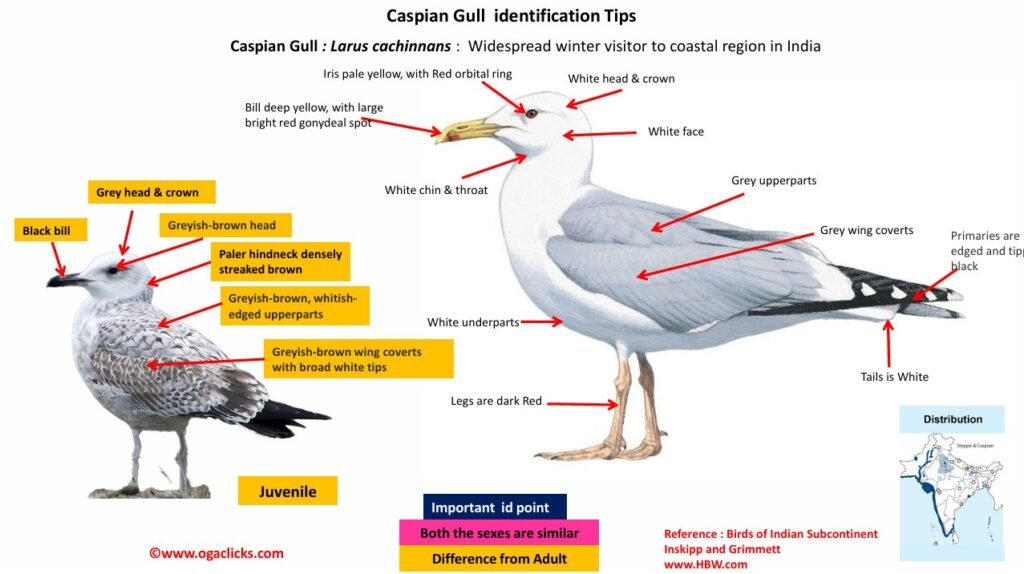
Caspian Gull Larus cachinnans
Etymology:
- Larus : Latin word for rapacious seabird
- Cachinnans: Latin word for laughing derived from cachinnare – to laugh aloud
Distribution in India: Winter visitor in Western coast and cost of Tamilnadu India.
Description: Size of 55-60 cm; wt. of 680–1500 g; wingspan of 137–145 cm. The breeding adult is a large white-headed, white-bodied gull, with grey mantle and upperwings, and black-and-white wingtips; bill deep yellow, with large bright red gonydeal spot; legs yellow; iris pale yellow, with conspicuous red orbital ring, but there is considerable variation in bare-parts coloration. It is typically lanky looking, with a comparatively small head, slender body and long, slender legs. Has a smaller, pear-shaped head, long sloping forehead, angled hindneck and long neck, with small-looking eyes set further forward in head, and slender, parallel-edged bill, with a gently drooping tip and weak gonys angle, yellow legs, vermilion orbital ring, blacker primaries, and slightly darker mantle. Non-breeding adult has unstreaked white head. The juvenile has greyish-brown head with white forehead, paler hindneck is densely streaked brown. The breast, belly and central undertail-coverts are whitish, greyish-brown, whitish-edged mantle and scapulars, greyish-brown greater coverts with broad white tips, dark brown tertials with pale tips, black bill and pale flesh-coloured legs and feet
Habitat: In breeding season found along coast and other marine habitats, as well as cultivated fields and is especially common at rubbish dumps and various other terrestrial habitats. Breeds on rocky and sandy islands, beaches, cliffs, spits, and grassy or shrubby river islands.
Food Habits: It eats fish, invertebrates, mammals, refuse, scraps, offal, bird eggs and chicks, and insects. Adults obtain food mainly by following fishing boats and taking offal. Forages mostly by wading in intertidal zone, plunge-diving, and following ships; also follows plough.
Breeding Habits: They breed in March- June in Europe. It is a colony breeder and makes a nest that is usually close together. The nest is made of nearby vegetation, feathers, debris and old carcasses; often builds or lines nest with eelgrass. It lays a clutch of 2-3 eggs. The incubation period is 26-29 days. The fledging period is 42-49 days.