Tree Pipit Anthus trivialis
Etymology:
- Anthus : Based on Greek mythology.Anthus, son of Antinous and Hippodamia, was killed by his father’s horses and metamorphosed into a bird which imitated theneighing of horses but fled at their sight
- Trivialis : Latin word for Common, Ordinary
-
- Harigntoni :Lt.-Col. Herbert Hastings Harington (1868-1916) Indian Army
Vernacular Names : Hindi: Musarichi, Ben: Muchassi, Munda: Ambal-serwi, Ta: Pulkuruvi, Te: Liku jitta, Mald: Fanfouduni, Mar: Vruksha Tirchimany
Distribution :
- Nominate – Wide spread Winter Visitor in India
- t. haringtoni – Found in North West Himalayas (Kashmir to Garhwal)
Description: It has a size of 14–15 cm; weight of 15–39 g.
It is a slim, medium-sized pipit with strongly streaked breast, rather heavy bill, shorter hind claw.
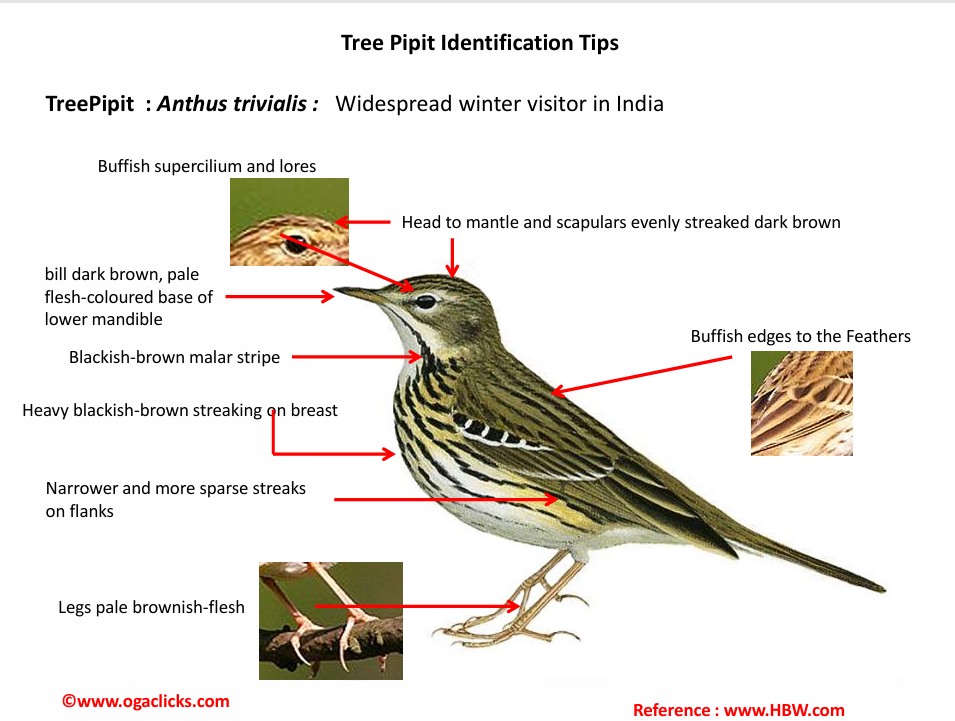
The nominate race has buffish supercilium and lores, brown and buff ear-coverts, and blackish-brown malar stripe. It is olive-brown above, top of head to mantle and scapulars are streaked dark brown, back more lightly streaked, rump is unstreaked. The primaries and secondaries are dark brown with narrow pale buff edges, tertials and greater and median wing-coverts are brown, edged whitish. The lesser coverts are brown, edged buff.
The tail is dark brown, T5 with small white spot on inner web, T6 white on outer web and most of inner web.
It is whitish below, pale buff wash on, particularly, breast and flanks, heavy blackish-brown streaking on breast, narrower and more sparse streaks on flanks underwing-coverts and axillaries dusky grey with pale buff fringes. The iris is blackish-brown; bill is dark brown, pale flesh-coloured base of lower mandible. The legs are pale brownish-flesh.
Both the sexes are alike.
The immature is more buff-brown, less olive, above, pale feather edgings often giving slight scaly effect, paler below.
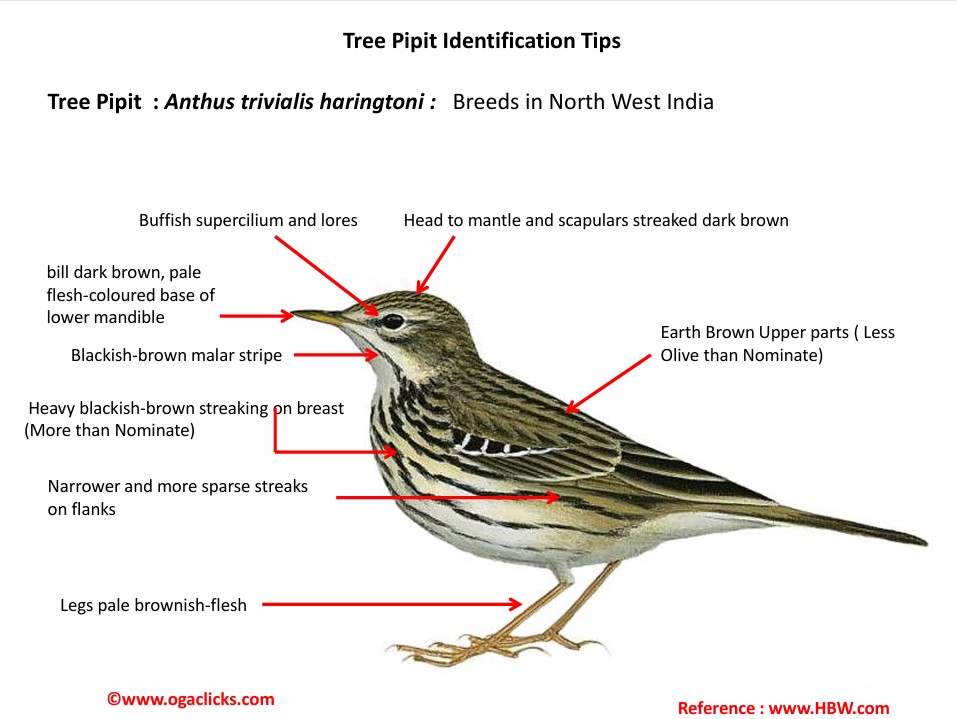
The race haringtoni has blunter wing and longer tail, broader dark streaks and paler olive-grey fringes on earth-brown upperparts, more heavily streaked black underparts extend farther down on flanks, also wider and deeper base of bill . it is slightly paler above, paler fulvous breast and flanks, heavier streaking on breast.
Habitat: It is found during breeding in woodland edge, open woodland, cleared woodland and young conifer plantations, often with isolated remaining tall trees, also heathland or grassland with developing scrub and trees. It is found from from sea-level to just above tree-line, 2800–4000 m in Himalayas (race haringtoni). On passage migration it favours similar habitats, as well as more open areas. In non-breeding season, it is found in in cleared areas in forest, in open savanna, and in cultivation and coffee plantations with tall shade trees.
Food habits: It eats insects; also some plant material in winter. The Nestlings are fed exclusively with invertebrates. It forages mostly on ground, mainly among leaf litter and low herbage, also occasionally on twigs, branches and trunks of trees and on stumps. It is found in small to medium-sized flocks on passage and in winter.
Breeding habits: They breed in May to Jul in India. They have two broods. They are monogamous, occasionally polygamous & territorial. Pre mating ritual has a song flight by male who makes angled ascent from tree perch and descends in parachute fashion, alights on same perch or another one. The nest is built by female. The nest is a substantial cup of dry grass, often with moss foundation, lined with finer grasses, placed in depression in ground. They lay a clutch of 2–8 eggs. The incubation is done by female. The incubation period is 12–14 days. The chicks are fed by both parents. The fledging period is 12–14 days, but chicks often leave nest several days earlier. The nests are parasitized by Common Cuckoo (Cuculus canorus).