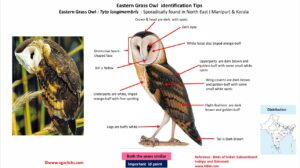
Australasian Grass Owl Tyto longimembris
Etymology:
- Tyto: Greek word for Owl derived from tuto
- Longimembris : Latin word longus –long; membris –with the legs. {Long legged}
Vernacular Names : Ass: Sun ulu sorai, Hindi: Bid ka Ullu, Maidani Ullu, Mar: Gavati Ghubad
Distribution : Resident of North East India. Have been recorded in South West India.
Description: The size of Male is 32–36 cm, weight is 265–375 g; the size of female 35–38 cm, weight of 320–450 g; wingspan is 112 cm. It is a medium-sized of Tyto with variable plumage. Male dark brown and golden-buff above with some small white spots; facial disc and underparts contrastingly whitish, tinged orange-buff, underparts with sparse blackish dots; flight feathers barred dark, with golden-buff patch at base of primaries; tail pale, barred dark; eyes dark. Darker than sympatric races of T. alba; generally, not so dark as T. capensis. Female as male, or with darker face and underparts. Juvenile resembles adult female, or darker. Australian birds (“walleri”) slightly buffier and on average with more dorsal and ventral spotting, could be confused with light-morph T. novaehollandiae; race chinensis entirely suffused tawny-buff, but some paler; pithecops larger, with some buff suffusion; amauronota like nominate, but slightly larger, upperparts more greyish, buff areas more yellowish, tail bars wider, female and juvenile with facial disc washed vinaceous-brown; papuensis upperparts plainer, darker grey with narrow white shaft streaks, not spots (but some nominate also with streaks), size approaching or equalling pithecops and amauronota; type (adult male) of baliem described as having upperparts much darker than papuensis and extending to two dark patches on sides of neck, possibly averages smaller.
Habitat: It is found in grassland, both tall grass jungle and open grassland, paperbark savanna, marshes, floodplains and heathland, also cultivated and cleared areas, including cane fields, and even wheat crops. It normally perches on ground, sometimes on tree.
Food habits: It eats rodents, small dasyurid marsupials, ground birds, reptiles, frogs, and large insects). It hunts entirely by low, quartering flight, with glides and hovers, like harriers, plunging head-first into grass. When rat numbers crash, many owls starve.
Breeding habits: They breed in Oct–Mar in India. They are usually solitary, but in favourable conditions sometimes loosely colonial, with nests separated by few hundred metres. The Nest is on ground in dense grass usually over 1 m high, or in sedges, usually away from trees. The nest is a flimsy pad or mat of grasses soon trampled by nesting activity, canopied in grass and with series of approach tunnels or pathways, even over shallow water, made by pushing through to nest; entrance to main tunnel flattened by frequent food deliveries. They lay a clutch of 4–6 eggs, laid at two-day intervals. The incubation period is 31 days The young fledge after 2 months They are hiding in grass during day and returning to nest at night and may stay around nesting area for some weeks.