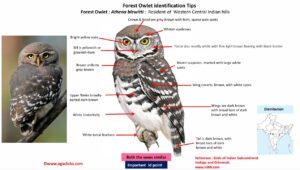
Forest owlet Heteroglaux blewitti
Etymology:
- Heteroglaux : Greek word heteros –different; glaux- Owl
- Blewitti : Named after British Civil servant WilliamTurnbull Blewitt (1816–1889)
Vernacular Names : Mar: Ranpingla
Distribution in India: Resident of hills of North Central India.
Description: Size of 20–23 cm; wt. of 241 g. the facial disc is mostly white with fine light brown barring; crown is grey-brown with faint, sparse pale spots; mantle and back are unspotted dark grey-brown, with obsolete hind-collar; brown scapulars marked with large white spots; flight-feathers and tail are with broad bars of dark brown and white, tail is broadly tipped white except in worn plumage. The below parts are mostly white, with dark brown bar across throat; breast almost uniform grey-brown, upper flanks are broadly barred dark brown, lower breast, belly, lower flanks, heavy tarsal feathering and undertail-coverts are white. The iris is yellow; bill is yellowish or greenish-horn. The flight is direct, not undulating.
Habitat: It is found in dry to dense moist lowland deciduous forest like teak. It occurs near villages and in habitats bordering agricultural fields. It often perches in shady middle stratum of forest in hot weather.
Food Habits: It primarily eats mice, lizards and small birds. It forages diurnally and is crepuscular. Most prey were taken on ground from perches; insects are also gleaned from branches
Breeding Habits: They nest in cavity in trees. The incubation period is 30 days. The nestling period is 40 days. The post-fledging dependency is 45 days.