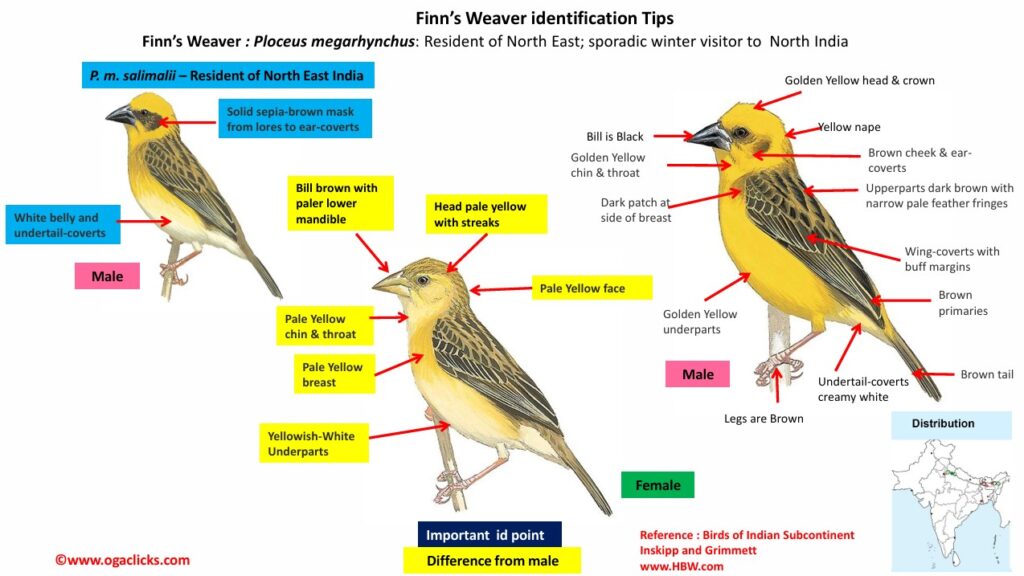
Finn’s Weaver Polceus megarhynchus
Etymology:
- Ploceus : Greek word plokeus – weaver, braider, plaiter derived from pleko – to plait, to entwine.
- Megarhynchus: Greek word megas –great; rhunkhos –
- Salimalii : Dr Sálim Moizuddin Abdul Ali (1896-1987) Indian ornithologist
Distribution :
- Nominate – Resident of North India (South Uttarakhand, North Uttar Pradesh)
- m. salimalii– Resident of North East India (West Bengal and Assam; Southern parts of West Bengal)
Description: It has a size of 15 cm; weight of male is 34–40 g, female is 30–34 g.
The male nominate race in breeding has forehead, crown and nape as golden-yellow, cheek and ear-coverts are brown. The mantle and back are dark brown with narrow pale feather fringes, rump is light brown with broad yellow tips. The upperwing and tail are dark brown, pale edges of remiges, and broader edges on wing-coverts. The chin, throat and underparts are golden-yellow, dark patch at side of breast may extend to form complete breastband on some individuals. The iris is amber-brown; bill is black; legs are brown.
The female breeding is patterned like male, but with paler yellow head and underparts, and no breast markings; iris is orange-brown or hazel-brown, bill is brown with paler lower mandible.
Both sexes in non-breeding plumage have forehead, crown and nape brown with dark central streaks on feathers, very broad streaking on mantle and back, unstreaked brown rump; wing and tail are dark brown, remiges and wing-coverts have buffy margins. The lores, cheek and ear-coverts are buff-brown, chin and throat are creamy white. The breast, flanks and thighs are buff-brown, centre of belly and undertail-coverts are creamy white. The iris, bill and legs are brown.
The juvenile resembles non-breeding adult, but with more buff on underparts.
The Race salimalii is like nominate, but male breeding has more solid sepia-brown mask from lores to ear-coverts, browner rump, and distinctively paler belly and undertail-coverts.
Habitat: It is found in grassland with scattered trees, especially in seasonally flooded areas; also found in rice paddies and other cultivated fields. It roosts communally in tall grass and sugar cane. It is found up to 1300 m.
Food habits: It eats seeds & insects. The young are fed mainly with insects. They forage in grass and rice paddies along with weavers.
Breeding habits: They breed in May–Aug in India. They are polygynous, with up to four females per male. They are colonial, sometimes in close association with other weavers. The nest is a ball-like structure lacking entrance tube, though often with porch-like projection over entrance. The nest is lined by female with soft grass-heads or bulrush fluff, supported by branches, leaves around nest are stripped and adjacent nests may be linked by strands of material; placed above ground in tree. They lay a clutch of 2–4 eggs. The incubation is done by female only. The incubation period is 14–15 days. The chicks are fed by female, occasionally also by male. The nestling period is 12–17 days.