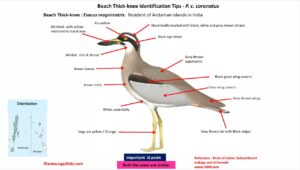
Beach Thick-knee Esacus magnirostris
Etymology:
- Hydrophasianus : Greek word hudro– water-; phasianos – pheasant
- Chirurgus : Latin word for surgeon
Distribution in India: Resident of Andaman Islands
Description: It has a size of 51–57 cm; Weight of male is 870–1130 g, female is 980–1020 g. It is a massive, thick-set thick-knee with heavy head and stout bill. The head is boldly marked with black, white and grey-brown stripes; bill is black, with yellow restricted to basal area; staring yellow eye; upperparts are unstreaked. It has broad wings rather square-ended and deeply fingered in flight, enhancing somewhat bustard-like appearance. It has medium-long, sturdy legs. On the closed wing, it has a blackish band across top edge of broad pale panel more marked in flight. The secondaries are all grey, inner primaries are uniform white.
The juvenile has duller bare-part colours; buff fringes to feathers of upperparts, especially upperwing-coverts.
Habitat: It is found in islands and mainland beaches. It is seen on beaches of sand, mud, stones and rock, both narrow and wide, sheltered or swept by surf; often at mouths of rivers, more rarely in tidal creeks. It frequents sandbars offshore and at mouths of estuaries; also on coral reefs and atolls. It is seen in mangroves also. It often flies out to sea when disturbed, before returning to beach; sometimes also found short distance inland on dunes, or around edges of coastal lagoons.
Food habits: It eats almost exclusively on crabs, where these are readily available; also eats other small crustaceans, It is usually observed by day, when feeds actively at times, but is known to be crepuscular and nocturnal also. It forages on rocks and large intertidal areas of sand, mud or shingle. It feeds by watching for prey then stalking it, or running forward with sudden, powerful forward lunge. It also probes into mud, sand and even short grass, but does not usually wade. The crabs are dismembered or broken into small pieces by hammering with massive bill, before swallowing.
Breeding habits: They breed in Sept–Nov. They are probably monogamous. They breed in isolated pairs, at lower density than other shorebirds. The pairs may be resident in the same area for several years; often associated with Little Terns. They nest on sandbank, sand spit or island, at back of extensive beach, among mangroves or grass. The nest is shallow depression, unlined but sometimes ringed with dead leaves and twigs. They lay one egg. The incubation period is 30 days or more.