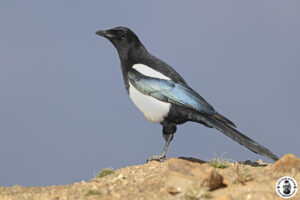
Black-rumped Magpie Pica bottanensis
Etymology:
- Pica : Latin for Magpie
- Bottanensis : French name for Bhutan
Distribution in India: winter visitor in Sikkim and North West Bengal bordering Nepal & Bhutan ( higher elevations in Chicken Neck area in East of India)
Description: Size of 46–50 cm; weight of male 185–247 g, Weight of female 161–240 g wingspan of 52–60 cm. It is a very distinctive magpie, mainly black and white, with long, graduated tail, mid-sized bill relatively wide at base, culmen downcurved distally. The nominate race has head to breast and most of upperparts black with inconspicuous purple and green sheen. The scapulars are white, narrow greyish band across rump. The upperwing is black, highly glossed green or greenish blue on secondaries and tertials, inner webs of primaries are white with black tips and bases, white usually concealed when bird at rest but forms huge band on open wing, The tail is black, highly glossed with green and reddish purple, becoming almost matt black at very tip. The flanks and central underparts are white, lower belly, tibia feathering, and undertail-coverts are black. The iris is dark brown; bill and legs are black. Both the sexes are similar. The juvenile is similar to adult but duller, with black areas of plumage unglossed and sooty black, white areas tinged buffy. When it is recently fledged it has patches of bare grey or grey-blue skin around eye and on malar, becoming much as adult by late summer.
Habitat: It is found in Broadleaf evergreen forest, pine forest, deciduous forest, forest edge, open woodland. It is found up to 1200 m.
Food habits: It eats Insects and other small arthropods. It forages in canopy and found often in cohesive parties in winter.
Breeding habits: They breed in April-July in India. The nest construction undertaken by both sexes, female doing bulk of building, male supplying most of materials, work takes 1–8 week. The nest is a rather large, distinctively domed structure, made from sticks and twigs, with side entrance protected by thorny twigs, deep cup thickly lined with soft materials such as wool, animal fur, soft grasses and feathers, usually placed at variable height in crown of tall tree. They lay a clutch 2-8 eggs. The incubation is done entirely by female. The incubation period is 21–22 days, the female is fed at nest by male. The chicks are fed by both sexes, mainly by male. The chicks leave nest after 24–30 days. They are dependent on adults for several weeks further.