Chestnut Munia Lonchura atricapilla
Etymology:
- Lonchura : Greek word lonkhe – spear-head, lance; oura – {Spear like tail}
- Atricapilla : Latin word ater- black; capillus –hair of the head { Black haired}
-
- Rubronigra : Latin word ruber red; niger
Vernacular Names : Ben: Nakalnur, Mani: Ushuk
Distribution in India:
- Nominate – North India (from Punjab to Brahmaputra Valleyto Bihar and North Odisha)
- a. rubronigra – Foothills of North India and Nepal terai.
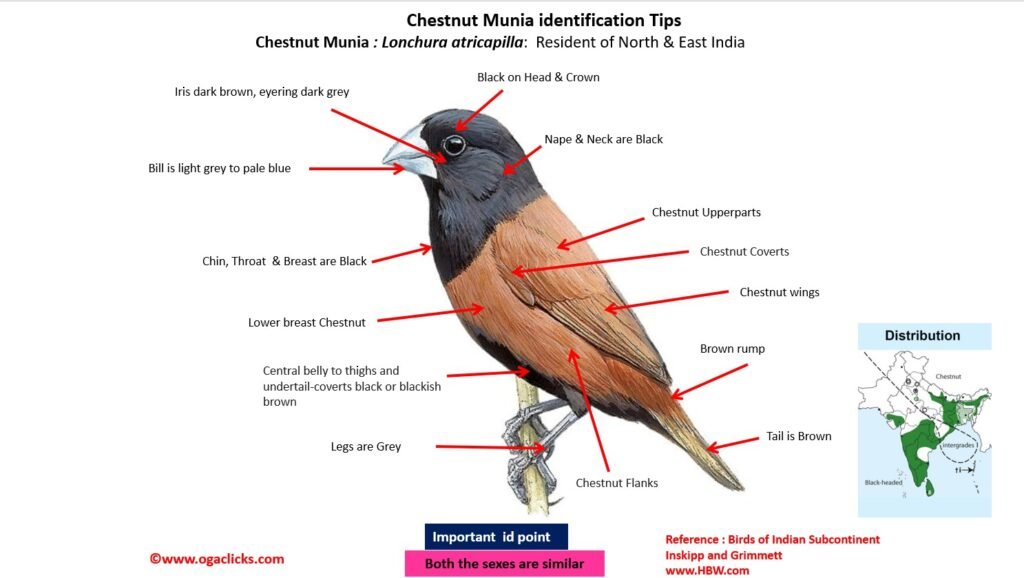
Description: Size 1–12 cm; weight of 10·1–15·8 g. The male of nominate race has glossy black on head to nape and breast, upperparts are dark chestnut, rump and uppertail-coverts are reddish chestnut, tips of longest uppertail-coverts and fringes of rectrices are golden-orange to pale golden-yellow. It has black or blackish brown central belly to thighs and undertail-coverts . The Iris is dark brown, eyering is dark grey; bill is light grey to pale blue; legs are dark grey. The female is like male, but hood is less glossy, upperparts are paler chestnut, dark belly patch is smaller. The juvenile is warm brown above, buff below; bill is blackish, becoming dark grey soon after fledging.
Race rubronigra has uppertail-coverts as dark brown, belly and undertail-coverts are black
Habitat: It is found in grassland, including cogon grass ,open wetlands, freshwater marshes and brackish margins of coastal mangroves, and rice paddies; also occurs in gardens. Found mainly in lowlands, from sea-level up to 1200 m in Himalayas.
Food habits: It eats grass seeds, including rice; rice favored food when available, taken mainly at growing milky stage It eats seeds while perched on stem, and feeds also on the ground. It forages socially, even during breeding season; sometimes in very large flocks.
Breeding habits: They breed in Jun–Sept in Indian Subcontinent. The male holds a grass stem in bill, and then, in upright or vertical posture with fluffed head, back and belly feathers, he bows head towards female, drops grass, and gives long complex song while bobbing; courtship is followed by bill-fencing and mutual preening. The nest is a ball with side entrance, made from grass and leaves, lined with finer vegetation, above ground or over water in reeds, grass or shrub or in tree. They lay a clutch of 4–6 eggs . the incubation period is 12–13 days. The nestlings are skin pink, naked, gape-flange is white, bordered with black streaks on inner surface, palate white with black band, tongue with two small spots, and a sublingual chevron. The nestling period is 3 weeks. The young are tended by both parents and become independent at 6–7 weeks of age.