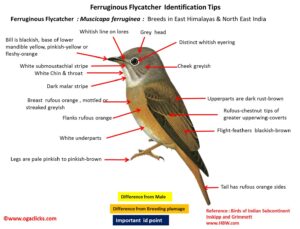
Ferruginous Flycatcher Muscicapa ferruginea
Etymology:
- Muscicapa : Latin Word musca – fly; capere – to catch
- Ferruginea : Latin word for rusty-coloured
Distribution in India: Summer visitor & Breeds in Eastern Himalayas and North East India
Description: Size of 12–13 cm; weight of 9–16·7 g. It is a small to medium-sized, broad-headed flycatcher with short bill. It has grey, upperparts to upperwing and lower back are dark rust-brown, rump and side of tail are bright rufous-orange. The crown and face are greyer, lores are pale orange-buffish, distinct whitish eyering, indistinct whitish or buff submoustachial stripe and dark malar stripe. It has rufous-chestnut tips of greater upperwing-coverts (forming wingbar) and edges of tertials. The chin, throat and neck side are white (partial collar), breast is light rufous, mottled or streaked greyish, becoming more plainly rufous-orange on lower breast, flanks and undertail-coverts, centre of belly is whitish. The iris is deep brown; bill is blackish, base of lower mandible is yellow, pinkish-yellow or fleshy-orange; legs are pale pinkish to pinkish-brown. Both the sexes are alike.
The juvenile is similar to adult, but heavily spotted pale buff on head, larger pale orange-buff spots with dark fringes on mantle, back and scapulars, rufous-orange fringes of greater coverts, tertials and secondaries, mottled with dark fringes on throat and breast, paler orange on rest of underparts.
Habitat: It is found in humid broadleaf forest, with preference for oaks, in fir forest in Himalayas, and in dense mixed lowland jungle in NE India. It breeds between 1200 m and 3300 m in India. In non-breeding areas occurs in mature and secondary forests in lowland and lower montane zone, up to 1500 m.
Food habits: It eats small invertebrates and larvae. It is usually solitary, shy or unobtrusive, and generally quiet. It is partly crepuscular. It forages in lower and middle levels of forest trees, often in small clearings and glades. It hawks insects from exposed branch in typical aerial pursuit, including acrobatic turns and short hovers, often returning to same perch; this frequently repeated for several hours.
Breeding habits: They breed in Jun and Jul. The nest is a cup-shaped structure made of moss, plant fibres and lichen, usually camouflaged on moss-covered branch or trunk. They lay a clutch of 2–3 eggs. The incubation is done by both sexes.