Lesser Shortwing Brachypteryx leucophrys
Etymology:
- Brachypteryx : Greek word brakhus short; pterux
- Leucophrys : Greek word leukos –white; ophrus- eyebrow
- Nipalensis : From Nepal
Vernacular names : Naga: Inrui-piji
Distribution : B. l. nipalensis – Himalayas from North India (Uttarakhand)
Description: Size of 11–13 cm; weight of 12·5 g.
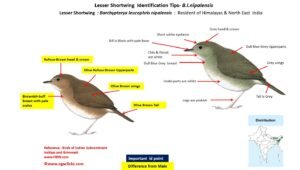
The male of nominate race is olive rufous-brown above, often concealed short white eyebrow, very short wings and tail. It is whitish below, with brownish-buff breast and flanks. The bill is blackish with pale base. The legs are long and pink.
Female is like male, but has weaker white eyebrow, paler bill base.
Juvenile is like adult but spotted.
The race nipalensis male is dull blue-grey above, whitish below, with pale dull blue-grey breast and flanks. The female is rufous-tinged olive-brown above, vague pale brown scaling on breast and flanks.
Habitat: It breeds in dense damp undergrowth in humid broadleaf forest and secondary growth, preferably near streams and in ravines, but also on hillsides and ridgetops, locally ascending into stunted forest. It is found between 1500 m and 2100 m.
Food habits: It eats insects, snails, slugs, grubs and beetle pupae.
Breeding habits: They breed in Apr–Jul in Himalayas. The nest is a compact dome with large side entrance, made of bamboo, leaves, roots and moss, lined with rootlets, leaf skeletons and dead palm leaves, placed within camouflaging vegetation such as orchid clump, dwarf bamboo or rattan, on or near ground, in low bush, or amid moss growing on rock or tree. They lay a clutch of 2–4 eggs. The nests is parasitized by Large Hawk-cuckoo (Hierococcyx sparverioides).