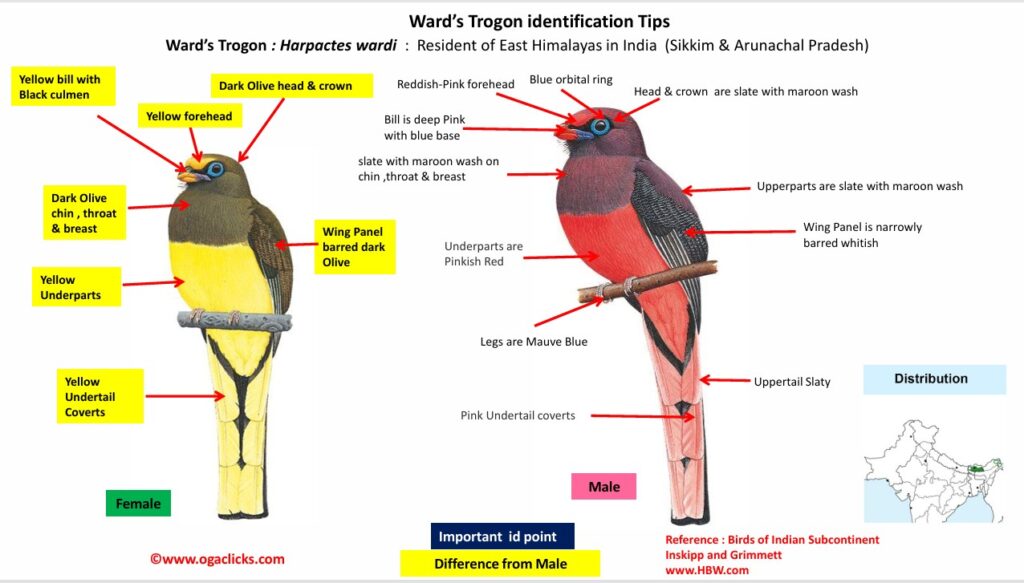
Ward’s Trogon Harpactes wardi
Etymology:
- Harpactes : Greek Word for “Robber”
- Wardi : Named after English botanist Francis Kingdon Ward (1885–1958)
Distribution : Resident of Eastern Himalayans in Sikkim to Arunachal Pradesh
Description: It has a size of 35–38 cm; weight of 115–120 g. The Male has bill deep pink, orbital ring pale blue; head, breast and upperparts are slate with maroon wash. It has a reddish-pink forehead and supercilium, underparts and outer tail, rest of uppertail are slaty.
The female has a yellow bill with black culmen; brownish-maroon areas in male are replaced with dark olive and pink areas with yellow.
The juvenile female has warmer upperparts (mantle and back), less yellow on forehead and much broader warm brown vermiculation on wings than adult.
Habitat: It is found in lower storey, undergrowth and bamboo in tall subtropical hill forest and temperate broadleaf evergreen forest, often with creepers and vines. It is found at 1500–3200 m.
Food habits: It eats Insects such as moths, stick-insects, grasshoppers and bugs; also eats berries.
Breeding habits: They breed in Mar and early Apr. The nest is an unlined hollow on side of rotten tree trunk or old woodpecker hole in deep forest, by a track or stream. The nest is excavated by both adults. They lay a clutch of 2–4 eggs. The incubation period is 17–19 .the incubation is done by both sexes, male by day, female at night. The nestling period is 12–14 days, with young being provisioned and brooded by both sexes. The chicks are brooded exclusively by female at night, and female takes greater responsibility for feeding nestlings. The young remain with adults for at least 7 weeks after fledging.