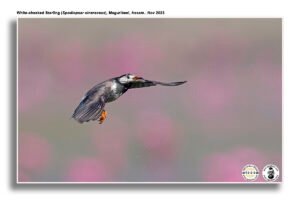
White-cheeked starling (Spodiopsar cineraceus)
Etymology:
- Spodiopsar : Greek word- spodios ash-coloured; psar starling
- Cineraceus : Latin word for Ash Grey
Distribution : Vagrant in India. ( Seen in North East India – Assam)
Description: It has a size of 22–24 cm; weight of 68–95 g.
It is a medium-sized, brownish-grey starling with nape and throat feathers hackled nape feathers also elongated.
Male typically has black forehead, crown and nape with some greenish-blue gloss, cheek white with some black streaking; head plumage is variable, sometimes largely dirty white with varying amounts of black.
The mantle and back are brownish-grey, rump is white; wing is brown with slight greenish gloss, outer webs of secondaries fringed white forming white wingbar on closed wing; tail is dark brown with slight greenish gloss, inner webs of rectrices are tipped white, more broadly on outer feathers.
Throat to upper breast are sooty-grey, sometimes with scattered white or white-tipped feathers, lower breast and flanks are paler grey to off-white, belly and undertail-coverts are white; iris is brown, sometimes with pale yellow inner ring; bill is orange to orange-yellow with dark base of lower mandible, in winter orange or yellow with dark brown tip of upper mandible and distal half of lower mandible; legs are yellow-orange.
Female is browner than male and lacks black cap, but has white cheek, white rump, and white tips of inner webs of rectrices.
Juvenile is like female, but has brown streaking on white cheek, rump whitish, remiges and rectrices lack gloss, and has bill dark horn with darker tip, legs horn-brown.
Habitat: It is found in open areas, including cultivated land, pastures, open woodland, parks and towns; sometimes in sparse, boggy larch, riparian woodland in Mongolia. Found up to 1300 m.
Food habits: It is omnivorous, but eats primarily invertebrates, insects, geckos and other lizards, frogs, earthworms, spiders, crayfish, isopods, beetles, larval butterflies, grasshoppers, flies and maggots, ants and bees. The mole-crickets often the main food fed to nestlings. It east fruits like cherries, mulberries and strawberries. Most food collected on ground. It forages on ploughed fields and on newly mown grassland, using open-bill probing to collect prey just below soil surface. In non-breeding range it forages mostly in rice-growing areas. It is always gregarious.
Breeding habits: They breed in Apr–Jul. They lay two broods. They are monogamous. They are found in colonies of up to 30 pairs. The nest an untidy structure of grass, lined with feathers, built in hole in tree or under house eaves, in roof cavity or in nest box. They lay a clutch of 2–10 eggs. The incubation is done by both sexes, female doing most of work. The incubation period is 12–13 days. The chicks are fed by both parents, nestling period is 21–22 days. There is interspecific brood parasitism. No eggs removed when parasite female adds an egg to clutch; late breeders appear to be responsible for most parasitism, behaving as floaters during early part of breeding season.